Stigma and Addiction
In 1970, American psychologist Bruce Alexander did an experiment known as "Rat Park". This experiment conducted by Dr. Alexander proved that stigma is very dangerous in addiction treatment. The normal responds when anyone is being stigmatized is to withdraw, it is human nature to go where you are loved and appreciated. In the Rat Park experiments " which showed that animals housed in enriched environments with access to other rats self-administered morphine much less frequently than those housed in isolation" (Volkow, 2020). When there is stigma, people isolates. There are no positive benefit of stigma. In Dr. Amarendran's lecture on stigma in substance use disorder treatment, He made good point on how stigma Limits access to care, stigma leads to patients being denied access to care, which leads to poor outcome, there is a decrease in trust, and plane and simple people lack understanding on substance use disorder. On Dr. Volkow prospective on stigma and the toll of addiction she acknowledge " Stigma not only impedes care delivery, it also most likely causes us to underestimate the burden of substance use disorders in the population. But stigma plays an even larger role in this crisis, one that has been less discussed: when internalized, stigma and the painful isolation it produces encourage further drug taking, directly exacerbating the disease" (2020). We need to be connected not isolated by stigma when it comes to addiction.

Impact of Opioid addiction on families
The misuse of opioid does not only affect the individual who is misusing but can affect the family as a whole. When a woman is pregnant and she continues to use opioid throughout the pregnancy, the child born can develop Neonatal Abstinence Syndrome (NAS) (2018). NAS according to Dr. April Dirks has been linked birth defects and sometimes severe life threatening withdraw symptoms. Despite this " In America, the number of infants born addicted to opioids is growing and it is thought that 6 out of every 1,000 births are linked to NAS" (Dirks, 2018). The BAART program in Vermont made a list of impact opioid addiction has on families. Some of the ways opioid addiction has impacted families includes but not limited t, leaving children in the care of their grandparent's, children ending up in foster care, leads to broken relationships, and families are expose to trauma (2019).
Andrew's Story
Andrew's story is a story of hope. The take home from this story was that, his addiction started unintentionally, it just happen overtime. He was very emotional sharing his experience with addiction. From his story, I found that emotions, tragedy, pain, dependency all played a role in his addiction process. There was also a breaking point, it came to a time Andrew knew he had to change. I am glad he found the needed treatment that worked for his recovery.
Addiction and Primary care
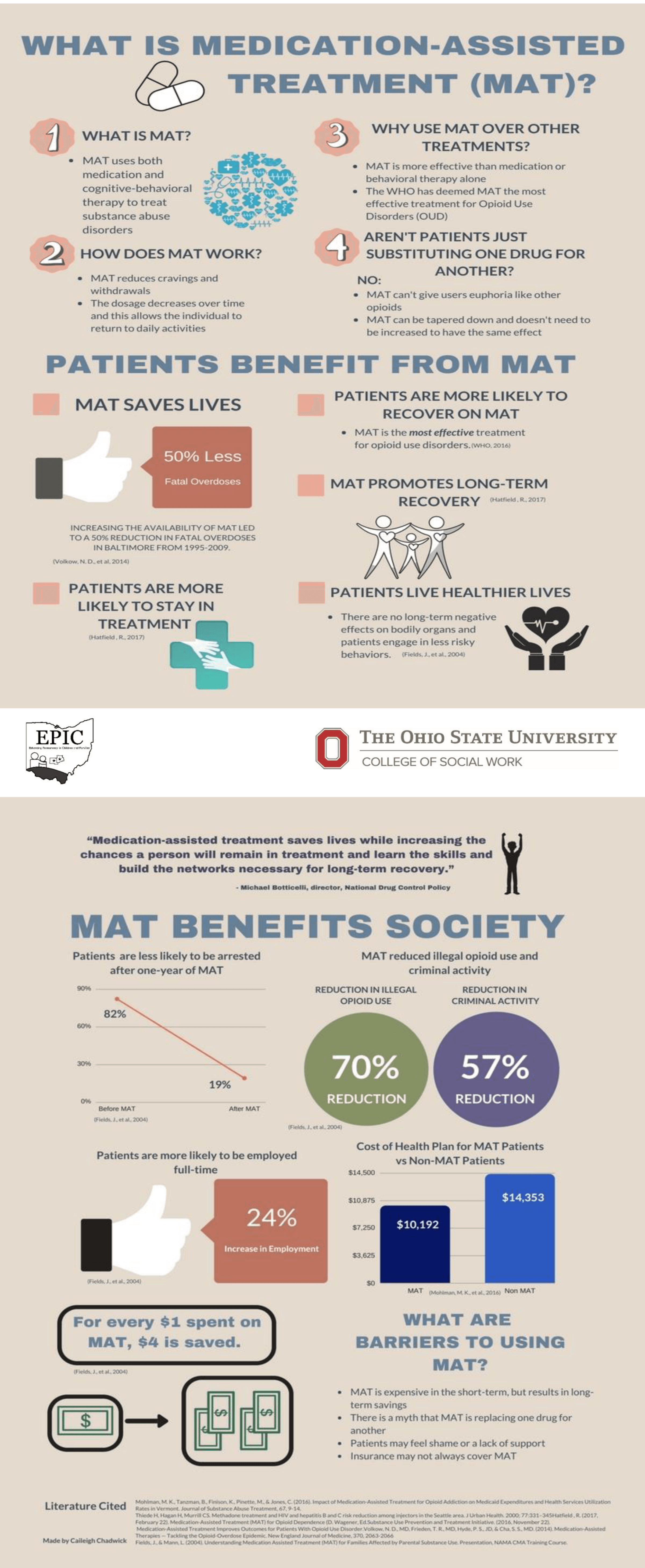
MAT waivers are needed so healthcare providers who are not certified in addiction treatment can prescribe medications like buprenorphine which is under MAT umbrella (NHSC,2021). All clinician should be responsible in treating substance use disorder. I think no matter the healthcare environment, all clinicians should know how to safely treat addiction. Treatment of substance use disorder should be a team effort.
Reference
Dirks, A. (2018, January 15). The opioid epidemic: Impact on children and families. Journal of Psychiatry and Psychiatric Disorders. Retrieved November 8, 2021, from https://www.fortunejournals.com/articles/the-opioid-epidemic-impact-on-children-and-families.html.
How to receive medication-assisted treatment (MAT) training. NHSC. (2021, September). Retrieved November 8, 2021, from https://nhsc.hrsa.gov/loan-repayment/receive-medication-assisted-treatment-training.
Opioid addiction: A family crisis: Treatment. BAART Programs. (2019, April 17). Retrieved November 8, 2021, from https://baartprograms.com/vermonts-opioid-addiction-a-family-crisis/.
Volkow, N. D. (2020). Stigma and the toll of addiction. New England Journal of Medicine, 382(14), 1289–1290. https://doi.org/10.1056/nejmp1917360

Comments
Post a Comment